


In a rapidly evolving business landscape, harnessing the power of artificial intelligence (AI) has become not just an option but a necessity for staying competitive. From improving operational efficiency, supporting sales teams to enhancing customer experiences, AI offers a plethora of opportunities for businesses to thrive.
This blog article explores how AI can be leveraged to solve business problems, delve into examples of its applications across various domains, discuss the challenges associated with its adoption, highlight some top AI tools for businesses, and provide actionable insights on how to start incorporating AI into your organization's operations.
How can AI be used to solve business problems?
AI technology presents a multitude of ways for businesses to tackle challenges and optimize their processes. Some common applications include:
Predictive analytics: Utilizing AI algorithms to analyze data and forecast trends, enabling businesses to make informed decisions and anticipate future outcomes.
Personalized marketing: Leveraging AI-powered tools to analyze customer behavior and preferences, allowing for targeted and personalized marketing campaigns that yield higher engagement and conversion rates.
Process automation: Automating repetitive tasks and workflows through AI-driven solutions, leading to increased efficiency, reduced errors, and cost savings.
Customer service automation: Implementing AI-powered chatbots and virtual assistants to provide real-time support and enhance customer experiences through prompt and personalized responses.
Supply chain optimization: Employing AI algorithms to optimize inventory management, demand forecasting, and logistics, resulting in improved supply chain efficiency and reduced costs.
Examples of how AI can be used in business
Here are some specific areas where artificial intelligence in business can make a significant impact:
Improve analysis and insights
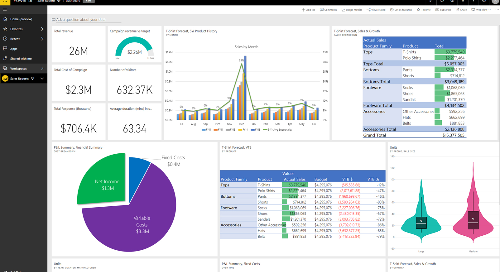
AI-powered analytics platforms such as Microsoft Power BI enable businesses to gain deeper insights from their data through advanced data visualization, predictive analytics, and natural language processing capabilities.
Process automation
AI-driven robotic process automation (RPA) tools streamline repetitive tasks such as data entry, invoice processing, and report generation, freeing up employees to focus on more strategic activities.
Enhance customer experience
AI-driven recommendation engines analyze customer preferences and browsing history to deliver personalized product recommendations, improving customer satisfaction and loyalty.
Product/content creation
AI-powered content generation tools assist businesses in creating high-quality content at scale, including articles, blog posts, and marketing materials, based on predefined parameters and user preferences.
Inventory management
AI-based inventory optimization solutions leverage machine learning algorithms to forecast demand, optimize inventory levels, and prevent stockouts, thereby minimizing carrying costs and maximizing profitability.
Audience segmentation
AI-driven customer segmentation tools analyze customer data to identify distinct customer segments based on demographics, behavior, and preferences, enabling businesses to tailor their marketing strategies accordingly.
Challenges when using artificial business intelligence technologies
While the potential benefits of AI in business are vast, there are several considerations to keep in mind to ensure its responsible and effective use. These include:
Data privacy and security concerns: Collecting and analyzing vast amounts of data raises ethical and privacy concerns, necessitating robust data protection measures and compliance with regulations such as GDPR, CCPA, and other data laws throughout the United States.
Bias and fairness issues: AI algorithms may perpetuate or amplify existing biases present in the training data, leading to unfair or discriminatory outcomes. Addressing bias requires careful data selection, algorithm design, and ongoing monitoring.
Skill gap and workforce displacement: The widespread adoption of AI may require upskilling or reskilling employees to adapt to new roles and technologies, while also raising concerns about job displacement in certain industries.
Overreliance on AI: While AI can augment decision-making processes, it should not replace human judgment entirely. It's essential to strike a balance between AI-driven insights and human expertise to avoid blindly following algorithmic recommendations.
Artificial intelligence tools for business
There are many artificial intelligence tools for business available today, but my favorite is Microsoft Copilot. Here's why:
Power BI Copilot. Excellent for advanced data visualization, interactive dashboards, and actionable insights, Power BI empowers businesses to transform raw data into meaningful insights for informed decision-making. It leverages AI through Microsoft Copilot to:
-
Enhance data analysis and make it more accessible. Acting as an intelligent assistant, it helps users more efficiently navigate through data, interpret patterns, and generate insights
-
Enable users to create reports automatically and uses generative AI to create narrative visuals that summarize reports.
Dynamics 365 Copilot. Dynamics 365 Sales and Customer Service leverage Copilot to enhance productivity and efficiency for sellers and service agents. Here are some ways it's utilized:
-
Dynamics 365 Sales Copilot enables sellers to ask natural language questions within the CRM system through chatbots, enabling fast retrieval of data. This streamlines workflows and allows more time for meaningful interactions with customers, setting the stage for increasing conversion rates and revenue.
-
Dynamics 365 Customer Service Copilot helps agents summarize cases and conversations, making it easier to manage and track customer interactions. In addition, supervisors and managers gain insights into agent productivity and customer service operations.
How to start incorporating AI into your business
Ready to embark on your AI journey? Here are some actionable steps to get started:
.jpg)