


Today, data plays a pivotal role in decision-making and strategic planning. Two terms that often surface in this context are business intelligence (BI) and business analytics (BA). While they are sometimes used interchangeably, they have distinct meanings and applications.
This blog article explores each, discussing the characteristics and differences between BI and BA and the roles they play in leveraging data for valuable insights that can significantly impact the way you run your business and build out your strategies.
What Is Business Intelligence?
Traditionally, business intelligence has been defined as the use of data to manange day-to-day operations. Leaders employ business intelligence tools and experts when they want to:
Collect and house data. BI tools help organizations gather and store data related to their current operations. These tools include spreadsheets, online analytical processing, reporting software, business activity monitoring software, and data mining software.
Maximize workflow. BI ensures that workflows are optimized by providing insights into historical performance. Leaders can identify bottlenecks, monitor key performance indicators (KPIs), and make informed decisions.
Produce informative reports. BI generates reports summarizing past performance, allowing organizations to assess their progress and identify areas for improvement.
Achieve current business goals and objectives. By focusing on current data, BI helps organizations stay on track and achieve their immediate objectives.
What Is Business Analytics?
Business analytics is actually a subset of BI, but it takes data analysis a step further. It involves using quantitative tools to predict future events and develop strategies for growth. Here are the key features of business analytics:
Identifying trends and predicting outcomes: Business analytics experts analyze raw data to extract useful information. They identify trends, predict outcomes, and provide actionable insights. Common methodologies in business analytics include data mining, aggregation, forecasting, predictive modeling, and data visualization.
Statistical tools and predictive modeling: Business analytics requires specialized skills and often involves data scientists. It leverages statistical tools, machine learning algorithms, and predictive modeling techniques.
Strategic decision-making: BA guides long-term planning and helps leaders adapt to changing market conditions. Unlike BI, which deals with the present, BA is forward-looking and aims to position organizations for future success.
What about data analytics? Data science?
If you're wondering about business intelligence vs. data analytics or business intelligence vs. data science, you must first understand the definition of each:
-
Data science looks at data on a macroscopic level and creates predictive models.
-
Data analytics deals with microscopic details and focuses on predictive analytics based on analyzed data.
-
Business analytics uses data to drive strategic decisions and improve business processes.
When doing your research on best practices and tools, it's best to focus on business analytics rather than data analytics or data science.
Business intelligence vs. business analytics: A head-to-head comparison
While BI and BA are related, it's important to understand the differences so you understand how to use each of them appropriately. Here is a high-level look at how they compare:
Present vs. future
BI: Focuses on current data and immediate operational needs.
BA: Looks ahead, predicting trends and shaping future strategies.
Company size and age
BI: Commonly used by organizations of all sizes for day-to-day management.
BA: Often employed by larger organizations with dedicated data science teams.
Personnel using the data
BI: Relevant for managers, operational staff, and decision-makers.
BA: Requires specialized data scientists and analysts.
Tools
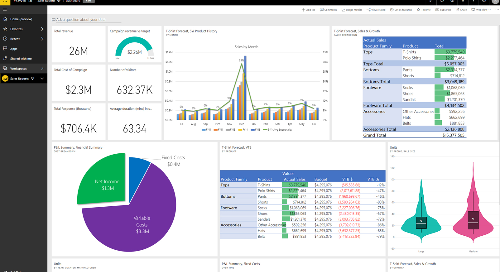
BI: Spreadsheets, reporting software, data visualization tools (e.g., Power BI)
BA: Statistical software, machine learning algorithms, and predictive modeling tools.
Note: See more later in this article about BI and BA tools.
Structured vs. unstructured data
BI: Primarily deals with structured data (e.g., databases, spreadsheets).
BA: Can handle both structured and unstructured data (e.g., social media posts, text documents).
BI and BA tools: Leveraging the power of artificial intelligence
Both business intelligence and business analytics have made a huge leap forward thanks to artificial intelligence (AI). For example, Microsoft Power BI has always been t
.jpg)