

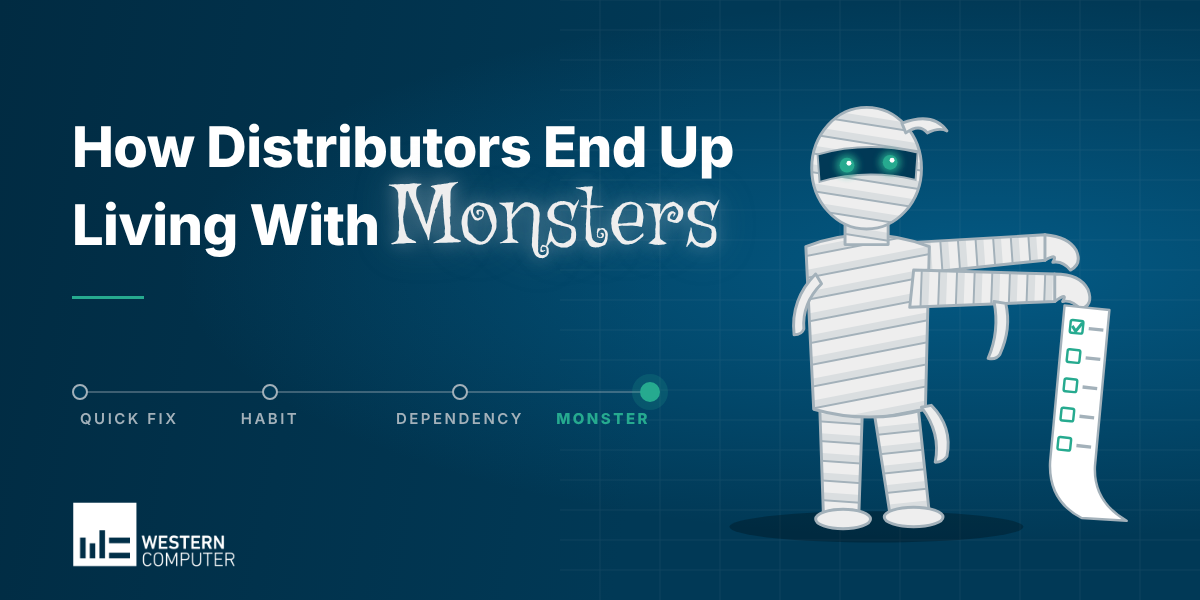


Nobody sets out to run a distribution business on spreadsheets. It happens one reasonable decision at a time. A buyer needs an answer the system can't give, so you build one. Five years later, the business depends on dozens of these fixes, and nobody can say exactly how many.
We call them monsters. Each one follows the same four-stage life cycle, and once you can see it, you can stop feeding it.
Stage 1: The Quick Fix Solves a Real Problem
Every monster is born as a good idea. A tariff changes and your ERP can't spread the new duty across the right receipts, so someone builds a landed cost spreadsheet "just for this shipment." Marketplace orders don't match the books, so the AP lead exports both and compares them by hand.
In the moment, these are the right calls. The order ships, the margin gets checked, and the problem goes away for today. That's exactly why workarounds survive. They work just well enough that nobody goes back to fix the root cause.
Stage 2: The Quick Fix Becomes a Weekly Habit
"Just this once" turns into every Monday. The spreadsheet gets a permanent spot on the shared drive, and a second person starts using it. The cost hides because it's spread across the team in small pieces.
Put a number on it. The median pay for bookkeeping, accounting and auditing clerks was $24.36 an hour in May 2025. A workaround that takes six hours a week costs about $7,600 a year in wages alone, before benefits or errors. Five of them cost about $38,000. Most distributors we talk to have far more than five. (Illustrative math: 6 hours x $24.36 x 52 weeks.)
Stage 3: The Habit Becomes a Dependency on One Person
Eventually one person understands the file. She knows which tab feeds which, which formula breaks in March, and why column K is hidden. The forecast, the reorder points or the landed cost model now live in her head as much as in the system. That's how the Spreadsheet Witch takes over.
The stakes are high. U.S. merchant wholesalers held $964.2 billion in inventory at the end of August 2026. When buying decisions for your share of that inventory route through one person's spreadsheet, a vacation, a resignation or a corrupted file becomes a business risk.
Stage 4: The Dependency Becomes a Monster That Holds You Back
The last stage shows up when you try to grow. A new warehouse means rebuilding the inventory spreadsheet. A new sales channel means another manual reconciliation. Warehouse and finance each trust their own workaround, so they bring two different inventory numbers to the same meeting.
Workarounds also block what comes next. Census Bureau survey data shows 19.8% of U.S. businesses used AI as of May 2026, rising to 32% of firms with 100 to 249 employees. AI tools need clean, connected data. When your real numbers live in side spreadsheets, there's nothing reliable for those tools to work with.
Why Workarounds Multiply Instead of Disappearing
If workarounds cost this much, why do they keep piling up? Four reasons show up again and again.
Each one solves a local problem. The person who builds it gets real relief, so it feels like progress.
The cost is invisible. A few hours here and there never shows up as a line on the P&L.
Nobody owns removing them. Building a workaround takes an afternoon. Retiring one takes a project, and projects need an owner.
Living with them feels safer. Changing a process everyone knows feels riskier than another month of the same spreadsheet, right up until the person who maintains it gives notice.
How to Break the Workaround Cycle
You don't need to fix everything at once. Start with a clear view of what you have.
1. List every workaround. Ask each team which spreadsheets, re-keyed entries and side databases they touch each week.
2. Put an owner and an hour-count on each. The math in Stage 2 makes the cost visible.
3. Sort by impact. Separate the workarounds that block growth from the ones that are only annoying.
4. Find the root cause. For each one, decide whether it needs a configuration change, a process change or a system that can do the job.
5. Stop new ones. Give every new spreadsheet an owner and an end date.
That list becomes the most honest requirements document you'll ever write, because it shows exactly where your current system falls short.
See How to Banish the Seven Most Common Monsters
Seven workarounds show up in almost every distribution business we work with. On Thursday, October 29 at 2 pm ET, learn how to replace each one with Dynamics 365, and how to tell which platform fits your operation. Western Computer has helped distributors run on Microsoft for nearly 40 years, with 1,750+ implementations. Register for 7 Questions That Haunt Every Distributor, and we'll send you the recording if you can't make it live.