




Your planning tool can get stock levels right and still keep your least profitable SKUs on the shelf. Here is how to spot them, and how Dynamics 365 keeps margin in view.
The planning project worked. Turns are up, stockouts are down, and the buyers trust the reorder points again. Then the CFO asks which of those SKUs made money last quarter, and nobody can answer without a week in Excel.
Why your inventory tool cannot answer the margin question
Inventory optimization and demand planning tools answer one question well: how much to buy, and when. They work in units, service levels, lead times, and turns. They take cost from the ERP, and in most legacy systems the item cost is the vendor price and nothing else.
Freight in, duty, brokerage, and drayage post to a general expense account, so they never reach the item. US merchant wholesalers are carrying $964.2 billion of inventory (US Census Bureau, October 2026), and in most legacy ERPs every dollar of it is valued without those costs. For importers the gap got wider fast. The average effective US tariff rate reached 11.4% in October 2025, the highest since 1943, and customs duties, taxes, and fees hit $287 billion for the year (Federal Reserve Bank of Richmond, January 2026).
The SKU that looks like your best performer
Gross margin return on inventory investment (GMROI) is gross margin dollars divided by average inventory cost. It tells you how many margin dollars each inventory dollar earns. Here is what happens when you calculate it twice, once on vendor cost and once with freight and duty included.
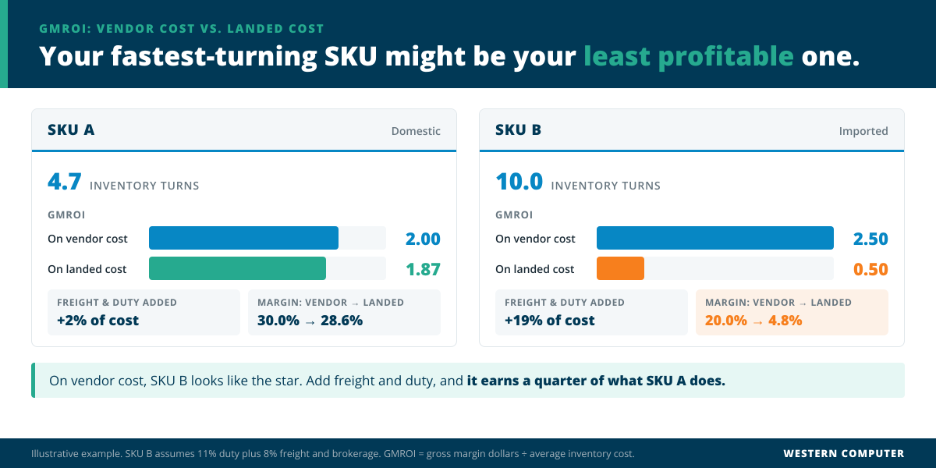
On vendor cost, SKU B is the star. It turns twice as fast and earns more per inventory dollar, so the planning tool works hard to keep it in stock. On landed cost, it earns a quarter of what SKU A does. Nothing about the planning was wrong. The cost it was planning against was.
How Business Central answers the CFO from one report
Dynamics 365 Business Central fixes this at the source. With Item Charges, freight, duty, and handling bills are assigned to the receipts they belong to, split equally or by amount, weight, or volume, and the cost flows into the item’s unit cost (Microsoft Learn). Inventory value and cost of goods sold now carry landed cost, so margin reflects what the goods cost to get to your shelf.
Dimensions do the rest. Tag sales and costs by customer, channel, branch, or vendor, and margin can be reported the same way your planners cut inventory. The GMROI test above stops being a week in Excel and becomes a report finance can run any morning. For most distributors in the $30M to $2.5B range, that is the whole fix, without more system than the team can run.
How F&SCM shows the margin before you buy
If you import by the container, Business Central’s item charges arrive after the fact, when the bills come in. Dynamics 365 Finance & Supply Chain Management adds the Landed Cost module, which estimates freight, duty, and handling on the purchase order, tracks voyages and containers while goods are in transit, and replaces estimates with actuals when the bills arrive (Microsoft Learn). Your buyers see the landed margin before they commit, not a month later. Planning and costing sit on one platform, so the number the planners use is the number finance reports.
Which tier fits depends on how much you import and how many entities you run. Our Dynamics 365 Finance & Supply Chain Strategic Assessment maps your processes against both before anyone talks license counts.
What to do with the SKUs that flip
Once landed cost is in the item, each SKU that drops below a GMROI of 1.0 needs a decision. The usual options:
- Reprice it. If the duty is permanent, the price list should know.
- Change the reorder policy. Lower the service-level target or stretch the review cycle so you carry less of it.
- Work the cost side. Consolidate shipments, renegotiate freight terms, or compare a domestic source.
- Retire it. Some SKUs only stay because nobody could see what they cost.
If the flipped SKUs are also slow movers, that is a cash problem too, which we covered in Cash That Is Sitting on a Shelf.
Margin is one of six costs an aging ERP charges finance
Western Computer has spent nearly 40 years and more than 1,750 Dynamics implementations helping distributors get planning and finance onto the same numbers. Invisible margin is one line on a longer bill. The CFO’s Hidden Tax walks through all six: the slow close, invisible margin, numbers your team keeps re-checking, cash trapped in inventory, overhead that only grows with headcount, and audit risk. It also includes a legacy-versus-modern benchmark table, a five-question self-check, a side-by-side look at what Business Central and F&SCM cost to license and implement, and how Investments Hardware got margin visibility across every sales channel.
Download The CFO’s Hidden Tax: What an Aging ERP Really Costs a Distribution Business

