
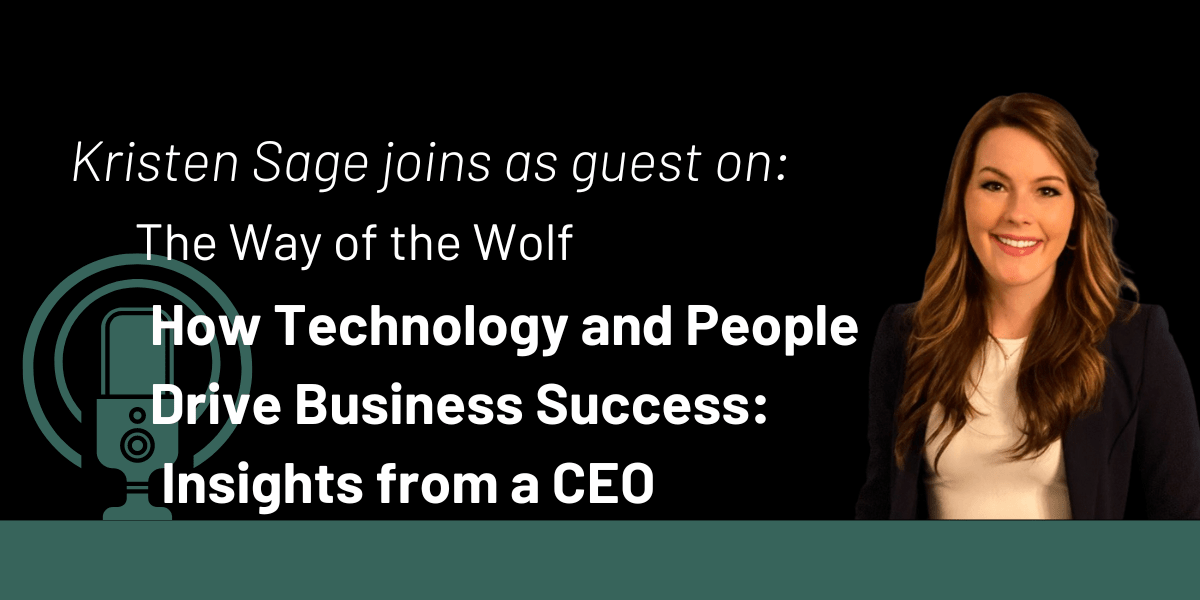


Kristen Sage:
Historically, I think technology has discussed a lot about how the system works, how we code it, how we do that, and it's like we need to change those conversations into like, what is the value your business is getting out of that?
Sean Barnes:
How is it going, ladies and gentlemen? This is Sean Barnes. I want to welcome you back to The Way of the Wolf. Our guest today, Kristen Sage, has an incredible journey that she has been on and I cannot wait to dive into it. She started out early on consulting at Deloitte, then transitioned into a management role at a transportation and logistics company, then to a director level role at a veterinary organization and is now the CEO of Western Computer. They specialize in Microsoft Dynamics and Power Platforms. And then recently were nominated by Microsoft as a top business central partner. Kristen, welcome to The Way of the Wolf.
Kristen Sage:
Thank you so much. Could not be more excited to be here.
Sean Barnes:
So here's the thing that's just really perked my curiosity is, how did you make that jump from consulting into management? Let's start there. You started at Deloitte doing a lot of consulting work and then went into management at an organization. Can you talk me through that?
Kristen Sage:
Yeah, sure. So perhaps even to take a step further back, I did my undergrad in accounting and finance, and at the time was advised, "Hey, accounting and finance applies to anything, so you should do that." Who knows what they want to do at the age of 22? Jumped out of that into Deloitte Consulting. And I think a mantra through the beginning parts of my career was it was really common to be told no, that there are certain things that you don't have access to. So when I first joined Deloitte, I joined their advisory side of the business focusing on insurance risk consulting, as odd as that is, and had wanted to make the transition into their consulting side of the business, they're quite similar, but due to my undergrad, they had said, "Hey, we don't recruit out of that undergrad into our consulting firm." I was like, "Okay. All right." So we've got a ceiling here, we're going to have to get through this somehow. It's going to keep coming up.
So I did well there, figured out that to get to the consulting side, if you got on a project and proved yourself, that's how you get buy-in. Proving yourself over and over again is how you get buy-in. Ended up on one of those projects and successfully was able to make the transition over to the consulting side. At which point, I started to look around and say, "Wait, I want to stay. There are incredible changes that this company could do. We're peeling off the onion and we're only getting to play with one piece of it because that's our scope of work," and I said, "But I want to do the whole onion."
And so at that time, going back to the ceiling that I was running into, I said, "Well, I'm going to have to get a different degree on my resume or this is always going to come up." And so I started applying for graduate schools at that point in time, happened to get into the University of Chicago, was getting my MBA there, met someone, proved myself, transitioned over into a company that that person was currently working at, which was the distribution company, and that's where I started really getting into general management rather than niche management focusing across everything from the people side to the process side, to the technology side. We were in charge of all of it for the specific area that we oversaw.
Sean Barnes:
There's a lot that I actually want to unpack there. So jumping from accounting and finance into all these other different areas and then now in technology, whenever I look at people that have jumped across functional domains, usually I will see people bouncing between accounting and technology because there's a lot of overlap and similarities, accuracy data, numbers, information, all of that. And so that is one thing that I find interesting, and you've actually jumped in through a lot of different domains, but more importantly, the thing that resonated, and I wrote a note here, proving yourself is how you get buy-in.
I see a lot of times people early on in their career or, let's be honest, throughout their career, they struggle. They grapple with, "Why won't people listen to me? Why won't people listen to me?" I think it's important that we build confidence through execution at a high level and that comes with time. And when you build that competence, it turns into confidence and it allows you to walk into any room, showcase you know what you're talking about and you can provide value, you can solve their problems, that gets buy-in very quickly. What has been your experience in that space?
Kristen Sage:
I mean, gosh, I'm going to unpack so much of what you just said too. I think there's a key element of that, which is understanding what the problem you're solving for is and what the people around you care about. So on the consulting side, even in our current business, we have a lot of customers on one project. We have the end user who's like, "Just make my job more efficient. Get this easier." We have a CFO who's like, "Do this on budget." We have the head of it who's, "Do it on time. I don't want to go through another audit on this old ERP. Just get it done on time."
All of those priorities are different and can impact things differently. And I think from a young age, those that are most successful are able to look around and say, "What are all of these other people's priorities and how do I help them get to their priorities? Because if they can raise, I can raise and they will pull me along with them because I am making their wheels spin faster. I'm not stopping it with self-interest."
Sean Barnes:
You said something that I also made a note of here. It's understanding the problem that you are solving for. I think a lot of times we have this myopic focus on what's right in front of us and we lose sight of the bigger, broader picture. Very unfortunate when that occurs, but a lot of people don't truly understand all of the interdependencies and different connection points. And when you're in technology, it is vitally important if you're implementing an ERP system, which we might get into here in a little bit, when you are implementing an ERP system, it's not just, "Okay. We're going to plug this new platform in." You have to understand the sales cycle. You have to understand pipeline, supply chain and how that feeds into inventory and then how everything moves through the system.
So it's extremely important that we have a holistic understanding of how the organization operates. When you do, you can then solve specific problems that occur in a very targeted way without any or minimal adverse effect on other systems, processes or teams.
Kristen Sage:
It's so true. I mean, a big project we worked on when I was at the distribution company was automating a big part of our technology and bringing in the IT folks, bringing in the finance folks, bringing in HR because we were automating a part of a process that leads to efficiencies. HR needs to be aware of that, was such an important part of the project. And when you bring people along on the journey and they were a part of it, at the end, they're your advocate. They're the one who's sitting in the room and saying, "No, I've been along on this. Let's do this."
I think the worst thing to do is catch someone off guard at the very end and be like, "Oh, we're running with this. It's too late. We've already done it," and they're like, "Wait, I wasn't a part of this." So to your point of you have to know the people what all of their priorities, again, see the big picture, bring them along, and that's really, I think, how you continue to advance in your career because now you have advocates across the entire organization who know your name, who know your work rather than just your direct boss.
Sean Barnes:
I'm keen to hear your thoughts on this. Over the years, I've had a lot of conversations with CIOs and CISOs and business leaders and it's not as common to hear the phrase digital transformation now, but if you think five to eight years ago, it was all the buzz. And I came to realize that digital transformation, it's not about the technology. I mean, kind of it is, but it's more about the people and understanding the needs of the business and understanding how to inspire and motivate and manage change for the organization.
And you said something a moment ago that resonated with me as far as, "Well, why didn't I know about this?" When you're implementing something, you have to get all the stakeholders involved and solicit their feedback from all of them and factor that in. I think that is a big miss that a lot of technology leaders maybe they struggle with because the CFO's hammering, "Hey, I can't keep spending money on these consultants coming in. You've got to meet these deadlines," and so they will try to move things forward and try to rush the process without getting all the feedback that they need to really make sure that it hits hard and everything comes to fruition the way they planned it to. So they hit the target deadline, but they've missed out on all this other stuff and it creates this mountain of technological debt that is going to have to be paid at some point.
Kristen Sage:
Most definitely.
Sean Barnes:
Really quickly, when you guys come in and start doing some sort of an implementation, how do you account for that?
Kristen Sage:
So you first come in, and I think what we're really pushing for, we are on this transformational journey right now about customer excellence. We're really trying to coach our team up on getting to the why, why are you doing this project, what caused it. Some people are doing ERP because their company has a growth trajectory and their lenders won't give them the money if they're on QuickBooks because there's not enough auditing strength on it. Other people are doing I'd say the cybersecurity tack, and they're like, "We can't go through that again." Other people are doing it because they know it's the future and they're like, "This is the foundation. Without this, I can't build the house. I can't build it on the rocky foundation. It will never work and I'll get too far behind."
So understanding where they are in that changes how we should approach a project. If it's an urgent, we just need to get it in, "Great. Okay. Let's get a foundation, a very small foundation built and let's phase out specific additions to it. Let's think about your CRM, et cetera, and phase two, but let's get your finance function up and running on it. Let's get your warehouse up and running on it and let's optimize." It's really different for every customer as to what is your tolerance, where do you need to move, how quickly do you need to move there, and then let's help you draw out the plan to get there.
Sean Barnes:
Okay. This is the topic that I geek out on and so I have to apologize. We went down a little bit of a tangent. I want to hear more about your story in terms of growing through management to director and then now into the CEO role for Western. Can you talk me through what's the most significant part of your story that you would like to share?
Kristen Sage:
That's such a great question. I think the most significant part was in each role where I felt like I wasn't being challenged anymore or wasn't able to touch as much as I wanted to touch, I started looking. So I found myself at the distribution company that I worked for, fantastic growth experience management. It was incredible, but it's a private family-owned company, and so there's no exposure to financials.
People geek out on systems, I geek out on accounting and finance, and so I said, "Give me my P&L back. I want to see this. I want to drive that." Moved on into the veterinary space, had the chance to run an 18-hospital portfolio. Really enjoyed it, but felt that I was getting back into the consulting side where I had 18 hospitals and I'd hone in and I'd help them on one thing and then another fire would pop up, and so I'd leave them and I'd go work on that hospital. I always found myself bopping around. I'm like, "Wait a second. I just want to grow one. I really want to focus on one."
And at that time, had the opportunity at Western Computer popup, and really, I think what drew me there was the legacy that already existed while also having the immense opportunity in that it's a 35-year-old company. You talk about digital transformation. I mean, this company needs to go through a transformation in the best of ways. We have a great foundation. For us to get even bigger, we need to transform the way we approach business. I think that perhaps the most pivotal part is always listening to the inner voice and saying, "I think there's more I want to do," and following that.
Sean Barnes:
I love that. Okay. So I'm actually going to go way back now and ask, has that always been a part of who you are, constantly having this desire as like, "I want more, I want to learn more, I want to grow more"? Has that always been who you were from even a young girl?
Kristen Sage:
Oh, gosh. Probably I would say, I commonly say that your best characteristics are your worst characteristics. I am stubborn and I've been stubborn since I was a little kid. My parents would say that. They'd say I can be a dog with a bone with an idea, and they would say, "When you would cross the road, you wouldn't look left or right. You were just like point A, point B, cross the road," since I was a kid. And so these are the best parts about me, these are the worst parts about me. It's commonly something that I have to balance. But I think that, yeah, the laser focus on I need to get there and nothing's going to stop me, and if you tell me I can't, I'm going to prove to that I can, that's probably always been in there. I'm sure someone could tell me why, but-
Sean Barnes:
This is something that over the last we'll say year or so that I've been reflecting a lot on, specifically about myself and my own journey, just wondering what was that driver because like you, I've always been intrinsically driven, wanting to learn, wanting to grow, wanting to do more, more, more, and I just took it for granted. It was just, "Oh, well, this is just who I am and how I operate."
And only recently have I started to self-reflect and evaluate. And there's some stuff that goes all the way back to my childhood that were some drivers, but to your point of our weaknesses can also be our strengths or strengths or weaknesses, I can't remember how you worded it, but I think it's important for us to have enough self-awareness to acknowledge, "Hey, I have this thing inside of me, this fire that burns hotter than hot. I need to make sure that I channel it in a direction that's meaningful and impactful and can help inspire and lift as many other people up as possible," because for the first few decades of my professional career, it was all about Sean, what can Sean accomplish. I want that six-figure salary. I want that director title, that VP title. I want my own company, all this stuff.
And once I got into probably my mid 30s or so, I realized that all these things that I wanted were just focused on me and it doesn't really matter. It wasn't fulfilling. It was cool when I hit that target, and then whenever I shifted my focus on building my team, building the people around me and lifting them up, that's when the fulfillment came. So I still have this intrinsic drive, but now the focus has shifted outward into helping to lift other people up. I think it's important for us, especially those in leadership roles, to make sure they understand themselves enough and can channel that in a direction to positively impact their organization, the people around them and start driving transformations.
Kristen Sage:
Yeah, most definitely. I think there is an enjoyment that people come from achieving things. One thing we recently focused on for our team is we announced that we're doing OKRs this year. It was the first time that the company had done those. It's getting the team to be like, "I'm a part of something." We as humans naturally want to be a part of something. It's built into our DNA. We're a part of this. We are all rowing on this boat for all of us. You're doing it for the person next to you, you're doing it for yourself. I mean, these are jobs, right? You don't do it for free.
I think that that's been really cool to see is the team coming together and saying, "Wow, yeah, this is our goal and we're going towards it." Just this year, we announced to be one of Microsoft's inner circle partners, which is a big deal in the Microsoft world, especially for smaller guys like us, smaller women, men, whatever, and it was cool. I think the team's like, "Oh, wow." It's not just us feeling this way. The external world's noticing it too. I think the team is just like, "Wow, this is cool. We're building this. We're all a part of it."
Sean Barnes:
It's also exciting, and I appreciate your we'll say transparency. Western Computer was founded in, what, '87? Is that right? Something like that? Okay. So this is something that a lot of organizations, I mean, every business is going to have challenges and struggles. As organizations grow and scale, as they mature, there's almost this double-edged sword here in that as you grow in scale, you are able to further leverage your economies of scale, which is great. However, what you end up doing is also building systems and processes to make sure you are as efficient as possible at a given operational scale, we'll say.
And then over time, as time goes on and progresses, you come to realize, "Okay. Well, that worked for us in the '90s. We're hanging onto it in the 2000s. Now it's the 2010s, we got to do something with it. Now we're in 2020." And so my question for you is as you stepped into this role as a CEO of Western Computer and start sizing up, this is a tech-focused firm and I'm not eluding or saying that you guys have tech from the '90s. I'm not saying that at all, but there are things that were built many, many years ago that you're having to unravel and then build back new.
Whereas let's just say a competitor launches today with a lot of funding, they're able to build from the ground up with the latest technology, and so they have some advantages there. However, you have advantages in that tacit knowledge from your team that has been in it for years. How do you balance that? How do you make sure that you maintain all these great systems, processes and structures that have gotten you where you are and also stay agile enough to leverage the newest technologies?
Kristen Sage:
I think what's been interesting for us is the way that we balance that is we listen to our people. We are fortunate. We have a very tenured expert team. I will joke with peers and coworkers. If I went up to my developers, business central, F&SCM, CE, any of them, Power Platform and I said, "Make a dance," they could do it. They are so good, so good. It's incredible. We do engagement surveys quarterly to discuss with them what do you want to see out of us. It's so interesting when you get those back because it is very much what we want to do with the business. So that's my weathervane. If there is something that I want to do with the business and I'm not hearing back from the team that we should do that, that's indicative to me that that's not something that we should break right now.
But if it's something that, for instance, right now, career development is a big thing we're getting asked for and I