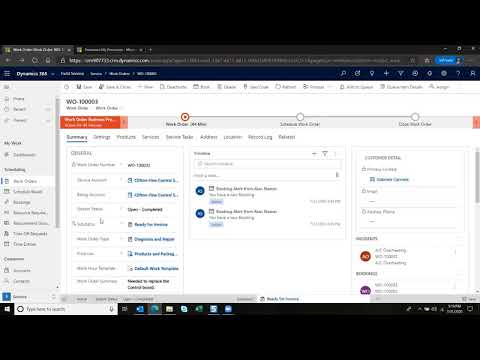



If your warehouse work instructions in Dynamics 365 feel like a black box, this video breaks it open. This walkthrough covers exactly how location directives and work templates work together to create and route warehouse work - no jargon, no fluff.
What you'll see in this video:
- What work templates do and why they define the structure of warehouse work
- What location directives do and how they determine pick and put locations
- How a sales order release triggers the work creation process
- How the system evaluates templates and directives by sequence number
- How both components combine to produce executable warehouse work instructions
Contact us for a personalized demo: https://bit.ly/32ChDNg
CALL: (805) 581-5020
VISIT: https://www.westerncomputer.com/
EMAIL: info@westerncomputer.com
FOLLOW US:
Facebook: https://www.facebook.com/Western-Computer-236693736372775/
Twitter/X: https://twitter.com/WesternComputer
LinkedIn: https://www.linkedin.com/company/western-computer
Video Transcript:
"In this segment, we will be discussing location directives and work templates in D365 Advanced Warehousing or WMS. When we talk about advanced warehousing in D365, location directives and work templates are the brains behind the entire WMS process. These two configurations work together to determine what work is created and where that work will happen. In this video, we'll walk through the basic work creation process in plain English without diving into all of the technical nuances or behind the seams logic. The goal is to help you understand how work templates and location directives work together.
At a high level, the responsibilities are simple. The work templates define what steps the warehouse worker must perform, such as picking and putting. Location directives determine which locations are used for those steps. A work template defines the structure of the work. The location directive supplies the locations. Together, they form warehouse work instructions.
Work creation always starts with a trigger, and the trigger depends on the type of transaction. Common examples include releasing of a sales or transfer order to the warehouse, purchase or transfer registrations, production orders reporting as finished, inventory movement, replenishment or cycle counting. To keep this simple, we will just use a sales order as our example.
On a sales order, under the warehouse tab, there is a release to warehouse button. Selecting this button starts the work creation process. In reality, the system checks inventory availability, reservations and valid picking locations, but we will set all of those aside and focus on the core flow. There are other ways to release multiple orders to the warehouse, but for simplicity, we will demonstrate this option.
Once released, the system looks for applicable work template. It does this by starting with the lowest sequence number, evaluating the query on each template and selecting the first matching template. Once a match is found, the system now knows what type of work to create, such as a basic pick and put.
Next, the system needs to determine where the pick and the put should occur. It moves to the location directives and evaluates items in sequence, lowest to highest sequence number, matching the directive type, site and warehouse. Evaluating the directives query, if one exists, when a match is found, the system moves into the directive lines. Location directive lines are evaluated from highest to lowest sequence, and these lines allow the system to narrow down logic based on quantity, unit of measure, unit restrictions, and once a line matches, the system evaluates the location directive actions again, working in sequence. This is where the actual warehouse location is selected, based on criteria, like location profiles, available inventory, or batch requirements.
Once all of these steps are complete, the system has a work template defining what to do, a location directive defining where to do it. The work is then created and made available for execution in the warehouse. While advanced warehousing offers extensive flexibility, understanding this core process is the foundation for designing effective and predictable warehouse operations. Thank you and have a great day."