


Kris:
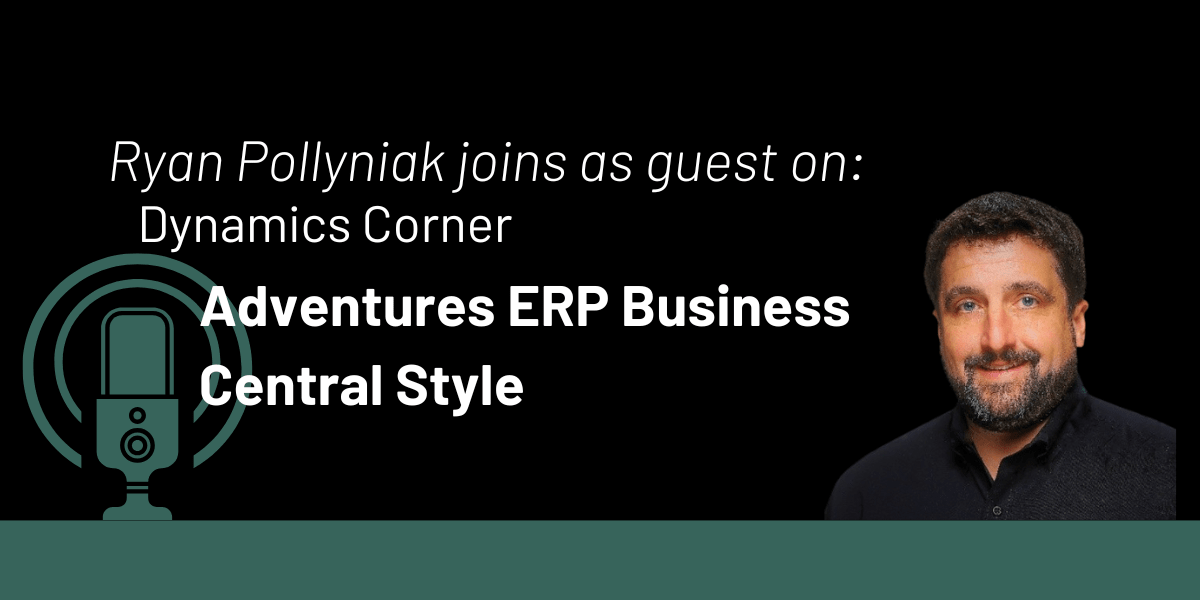
Welcome everyone to another episode of Dynamics Corner. How do you build an ERP? It's just like building a deck. I'm your co-host, Kris.
Brad:
And this is Brad. This episode was recorded on March 20th, 2025. Kris, Kris, Kris, how do you build a house? How do you build a deck? How do you prepare for an ERP implementation? And you have to listen to the entire episode because they were four quotes that I now put down on my list of quotes as we recorded this episode. With us today, we had the opportunity to speak with Ryan Pollyniak. Good morning, sir. How are you doing?
Kris:
Yo, yo.
Ryan Pollyniak:
Good morning guys. How are you?
Brad:
Excellent.
Kris:
Good.
Brad:
Haven't had the chance to talk with you in a while, but I see you're doing some great things.
Ryan Pollyniak:
I don't know about that. I don't know who told you that, Brad, but-
Brad:
Listen-
Ryan Pollyniak:
... I do stay busy. I know you guys are doing great things. The podcast has taken off.
Brad:
Great. Thank you. Well, it's all because of individuals such as yourself who take the time to speak with us.
Ryan Pollyniak:
My pleasure.
Brad:
We're the boring guys. It's the individuals that we speak with that have a vast wealth of information to share and experiences, which makes it nice.
Kris:
Yeah, well.
Ryan Pollyniak:
Pleasure to be here guys,
Brad:
And we appreciate that. I've always looked forward to speaking with you. I get closer and closer to you every time. We still have to get a hike in.
Ryan Pollyniak:
Yeah, I know. And you have to turn words into action at some point, right? And for me, free time is such a premium with three little girls. They're all in gymnastics. We do that every day but Wednesday during the week, and right now every weekend is a meet. That's it. Busy job in the ERP business and between that and the gymnastics, that is what I do. And I am not complaining, by the way. I do love it. I love hiking too, and you got to make some time for that kind of thing, and I will get up there and go for a hike up there in the White Mountains with you at some point.
Brad:
Absolutely. I like the turning words into actions quote. I'm going to steal that.
Kris:
That's important.
Brad:
I think that on time, everybody says that they don't have time, they don't have time, which is true and everyone has busy schedules. It's a matter of what you do with your time, and I'm happy to see that you're doing it with your little girls in gymnastics because I'll tell everyone, when your children get older, all that complaining that you're doing about the meets on the weekends or the soccer tournament, lacrosse tournament, so whatever you have, you miss it.
Ryan Pollyniak:
That's right.
Brad:
You go through it and you're like, "Ah." It's just a struggle, but you actually miss seeing it. And now I appreciate being able to see others in those tournaments and those meets and I miss it and I appreciate seeing the kids having fun and doing things. I hope your girls are doing well with it.
Ryan Pollyniak:
Yeah, absolutely. And don't interpret it as a complaint. I do love it. I've got the vanity plate coming, which is a surprise. I checked availability. Gym dad is available in Georgia right now in my county.
Kris:
Nice.
Ryan Pollyniak:
I've got like two months until my tag renewal comes, so I check it every couple days. It's still there. I love it, Brad. I mean, no question about it.
Brad:
Absolutely.
Ryan Pollyniak:
You only get to do this for a while, right?
Kris:
Yeah. Short time
Ryan Pollyniak:
Hiking is passion of mine, I love it, love hanging out with you. We're going to make that happen. And I do believe big time in you are what you do, not what you say.
Brad:
Correct.
Ryan Pollyniak:
That was a quote that a guy from my past that I used to know in the business world gave to me and said, "Look, say whatever you want. I am going to, I was going to, I meant to, I plan on. None of that really matters. You are what you do at the end of the day, not what you say."
Brad:
That's two quotes I'm stealing from you.
Ryan Pollyniak:
There you go.
Brad:
No, that is so true. You are what you do. Words means just that, they're words. It's your actions and what you do to stand out. This is all philosophical. Do you get on the balance beam yourself with the girls? Do you get out there [inaudible 00:04:45]?
Ryan Pollyniak:
You see the balance beam? Oh, wait a minute. We do have one down here. So I thought maybe it was in the background. No, not really, anyway. I mean, I've walked across the thing a few times, which I consider a win at this stage and they're doing cartwheels on it and turns and this.
Kris:
That's impressive.
Brad:
I do not know how individuals that participate in gymnastics do some of the stuff they do. I'm with you, Ryan. I think I would just take a win as just being able to get up on a balance beam and stand for a few minutes, never mind walking or doing some of the flips and the bounces. When you see one on TV, it looks like it's maybe three feet wide and you could put a party up there, but when you see them in real life, they're only a few inches wide, right?
Ryan Pollyniak:
Four, regulation is four inches. Right?
Brad:
My foot's not even four inches. I mean, my foot's larger than four inches.
Ryan Pollyniak:
So imagine doing a back handspring, where you're literally launching yourself backwards and landing on your hands on a four-inch wide balance beam. I mean, it's incredible.
Kris:
That's impressive.
Brad:
I cannot do it. I'm very happy that you get to do that with your girls, it must be amazing to watch and hopefully they can do it injury free too. Because I know if I was on that balance beam or hanging on something like that, I'd be in the ER every day.
Ryan Pollyniak:
My eleven-year-old went to middle school on crutches today. She just sprained her ankle, so not too bad. We've been relatively injury free between the three of them, but yeah, it's a concern. But look, you got to take the bubble wrap off and let them live, right?
Brad:
Absolutely.
Kris:
Yep.
Brad:
Absolutely. And they get a lot out of it too. A lot of lessons learned with doing athletics when you're young. But enough of the philosophy. I have two quotes I'm going to steal from you. I'll have to cite you I think on there. Maybe I won't, but at least now we know where we got them from. Before we jump into the conversation, can you tell us a little about yourself?
Ryan Pollyniak:
Yeah, sure thing. Obviously, we covered, I'm a father of three and a husband, first and foremost, family first always. But right behind that is professional life. I've been doing Microsoft Dynamics. I've been in the industry now, it's hard to believe, 17 years, I think I've been saying 15 for the last couple of years. I keep forgetting that the years are progressing. And I've been working with Western Computer implementation and support partner for Microsoft Dynamics almost 10 years. It'll be 10 years in May, believe it or not.
Brad:
Wow.
Ryan Pollyniak:
So it's been quite a while working with companies to understand their needs and to evaluate fit and to navigate the complex world of Microsoft Dynamics, which you guys know is ever-changing, especially in the SaaS world these days. And so I've described myself sometimes as a Sherpa, you've got an executive or you've got a business leader or even somebody who's been assigned in their organization, "Hey, go get quotes and demos for the ERP." That's a tall order for somebody who's not living and eating and sleeping and breathing this stuff. So I take these people under my wing and I say, let me be your Sherpa, let me be your guide. Here's what to look out for, here's what's a fit, here's what's not a fit. Maybe Dynamics isn't a fit, or maybe Western Computer isn't a fit.
And then send them on their way to go work with somebody who may be more tailored to their particular needs. And that's important. Nobody wants to get into things that they're not well suited to help with. And so guiding people through their ERP journey, CRM journey and helping them understand the Microsoft Dynamics stack, that's what I do every day and I do love it. I'm passionate about it, and so consider myself lucky.
Brad:
No, it is, you do a great job. And I appreciate what you say, is you talk with customers, prospects, individuals looking to undertake the ERP journey, and you are absolutely correct, it is changing, ever-changing. I think by the time we're done with this recording, things will have changed from where we started.
Ryan Pollyniak:
Yeah, I'm sure.
Brad:
But I do appreciate, as you had mentioned, is finding the right fit, implementing ERP system, it can be many different things to which it's not so generic. It's what's involved. And finding the right partner or finding the right application to help you or assist you or guide you on that journey is extremely important. And finding someone such as yourself that can take the time to tell you, we may not be the fit for you, or maybe this isn't the product for you, but also this is a product for you and this is how you can determine it's extremely important and it makes for a better relationship. And that's one of the most important things I'm starting to stress and emphasize, because I see more how important it is in this world of where everybody's thinking, I hate to... I don't even want to say it, but where everything's becoming more automated, that relationship and that guide, that relationship and the trust that you have with someone, it becomes more and more important. And it's great that you're doing this stuff 10 years, that's-
Ryan Pollyniak:
A decade.
Brad:
... that's a long time. And then 17 years, I'm trying to think. Man, so I've known you for a while.
Ryan Pollyniak:
It's been a while. Yeah-
Brad:
I'm trying to think.
Ryan Pollyniak:
I didn't have as many grays as I did back then, and that ties back to the three daughters thing. But time flies, it moves pretty quickly. And that part you were just talking about ever-changing, I mean now more than ever, and I try to convey this to anybody looking at ERP. Long-term relationships with an implementation partner, consultant, whomever is going to be your guide here, it's more important than ever because the days of having a product NAV 2005 and you wait 10 years and then you upgrade, it's over. And I mean, this stuff is changing twice a year on a major level and more times than that on a minor level, if you don't have somebody guiding you through the update process, taking advantage of new features and what's your long-term strategy to help me evolve as a company, that is now more important than ever. Because the application changes constantly. So you've got to take that into account, I think as you go, evaluate relationships with technology partners.
Brad:
With ERP software implementations and the changing of implementations, when you're working with customers or even maybe not someone you're working with, what is some advice or some views that someone can take when they're going to, this is such a big question that I'm going to say in a very small, very few words, a small amount of words I hope, sometimes I can ramble. When someone's undertaking their journey to look either for a new ERP software application, or when they're looking to maybe upgrade their new ERP application, I know there's some challenges or some things that someone needs to look out for that they come along the way. What are some words of wisdom or some advice that somebody should go through to undertake that journey?
Ryan Pollyniak:
Yeah, man, we could talk about this one for a while, so let me try to go as basic as I can to start. You have to have a long-term plan and vision. And so what I've heard sometimes is, "Well, we just want to take what we have, and we want to move it into the cloud, and then we'll optimize processes after that." "Let me just look at the next step in the journey and then we'll figure out the rest of the way that we're going to go." I mean, that's a very dangerous thing to do because you're very likely to box yourselves in and prevent yourselves from actually achieving the things that you want to achieve down the road. So it's fine to take a phased approach and to walk and crawl and run and to evolve with how far you're going to take your technology, but you better have a plan that starts at the beginning and has concrete steps that you can then follow.
So let's say for instance, taking NAV to Business Central. Yeah, we have upgrade tools. We can migrate the data, we can migrate the configurations, we can take your custom code into BC, but then you're locked into quite a number of core decisions, locations and inventory costing and dimensions, and all of this data that's in there now somewhat limits what you can do going forward. Maybe you've acquired additional companies and you need a stronger multi-entity solution. Or maybe you have divested companies and you don't need half the mods you used to have. Well, it's okay to walk and crawl and run, but if you're building a ten-story building and you're only building the first two stories now, when you build the foundation, it better be for 10 stories.
Because otherwise, you're going to build two, and then you're going to have to tear the whole thing down and build the ten-story building. So on a high level, that's the number one piece of advice that I would give executives decision makers. As you plan this out, you don't have to do it all at once, don't let anybody make you pile too much into the initial project. That can be daunting, and that can be a pitfall as well, right? Change management is critical. If you change everything at once, you have a lot of internal bandwidth required to do that, you have a lot of change management challenges with people changing everything at once. So you don't have to do that either, but you do have to have a plan and you better make sure that that first step has the long-term vision in mind or you end up boxing yourself in.
Kris:
Does the conversation have to start internally before they even start looking for partners and such?
Ryan Pollyniak:
Yeah, 100%. So how can you make a plan for how we're going to get somewhere until you know where you want to go? And that has to happen internally. Now, it may be valuable to ask for the advice of some technology partners. Don't let them get you into a high pressure sign by the end of the month, signed by the end of the year, get a big discount type scenario because it's not in your best interest. But you can glean some advice from the right people and certainly that needs to start internally. And one part of that is informing the organization very early, and this has to start earlier than most people think that the change is coming. And you can tell people change is coming and "Hey, we are changing our ERP. We are changing our CRM." Anyone who has kids, you tell them to do something, "Go do this." It's the first question they're going to ask for your internal people. What's the first question your kids are going to ask?
Brad:
"Why?"
Ryan Pollyniak:
Why. Every time. So you better be ready to answer that for your people in a meaningful way. We are changing because we're on ancient technology. We can't aggregate data and drive business decisions with our data. We are at security risk because we're at an old on-prem system that is ripe for cyber attack. We're falling behind our competitors, they're upgrading, they're getting their data in order and preparing for taking advantage of all the great competitive advantages that AI is going to present that maybe we don't even know what those are going to be yet, but you better be ready. You can't be on disparate on-prem systems with half your data in Excel and expect to go take advantage of the AI that's coming down the track because we won't be ready to do that.
So explaining the why to everybody in the organization, "We are changing. We're going to go evaluate solutions. Here's why we're doing it." It's important because your people will sometimes have some apprehension, "Hey, we've been using our AS/400, we've been using GP for 20 years. It works just fine. Why are you trying to ruin my life?" I mean, you've got to explain that internally if you're going to have buy-in. So it goes beyond that, it goes beyond just why are we doing it as an organization, but how does it impact me?
"I'm the AP clerk and you're telling me we're going to implement AP automation, that concerns me." "I've been writing paper pick tickets in the warehouse for 15 years and you want me to use a scanner? Why am I doing this?" "I'm a salesperson who has this great notebook with all my notes on it and I don't need a CRM." You have to explain, "Well, here's what's in it for you. You have all these notes in your notebook. If you can get that into a system and allow it to prioritize your tasks for you and track your notes and update you when it's time to contact somebody and prioritize which opportunities might be most viable, it's going to, it's going to help you close more business. It's going to help put money in your pocket."
Just as an example on the CRM side, right? People need that. "What's in it for me?" WIIFM, if you guys have heard that acronym, like "What's in it for me?" And you have to always put yourself in someone else's shoes and think of it from their perspective. "Why are we changing as an organization? It works fine." "Well here's why." "Well, how's it going to impact me?" "Here's how it's going to impact you. It's going to be positive." So I think those are some definitely, to answer your question, you've got to start that conversation internally very early.
Brad:
That is so important and often overlooked, because some of the most successful implementations I have seen have been those implementations that included the individuals that are going to actually go through the journey with them because they have some, what do the people say? User adoption or user acceptance, in a sense. Because if they understand and they feel if they're part of it, they're going to work better to help make it successful and understand instead of being apprehensive and maybe potentially having, as you had mentioned, maybe some fear of the new system because they have been using that AS/400 system for 15 years and now you want me to use a new system, I'll be uncomfortable like the fish out of water as they kind of say. So now what's going to happen? I'm not going to be able to do my job.
Kris:
A question on that, when you're talking about change management, what is it for them. Who should deliver that message? So especially when there's a big change coming and you're going to have to talk to individuals or individuals that is going to be affected by this change, who should deliver that message?
Ryan Pollyniak:
In my opinion, the first message should come from the top. It should be, maybe it's an email, maybe you have a monthly or quarterly company meeting with everybody on board and you're updating, "Here's the status of the organization and here's where we're at." And we do that internally and our CEO Kristen leads that. She talks about the big things first, right? "Here's where we're going." She's the captain of the ship. So where are we going first of all, in general and why I think that message best comes from senior leadership, maybe even all the way at the top. If we were going to make that change internally, I could tell you right now, Kristen would be the one to announce it. "Here's where we're going guys." But then some of the more granular stuff, "How does it affect me personally?" That probably needs to come from someone who more directly manages your role, your direct report maybe or somebody, maybe a sales VP or a marketing VP or COO or somebody one level down to, "Hey, let's disseminate this on a more granular level."
But the why is also probably important to come from the top. It can't be, "Hey guys, we're moving off of our AS 400. We need to get on a cloud-based system, so thanks for coming." It can't be that, it has to be all the things that we talked about. "Here's why. Our competitors are getting ahead of us. We're not able to take advantage of our data. We have security risks. We're all in the same boat literally together as an organization. So here's why we need to steer it in a new direction from a technological technology stack foundation, from a technology stack perspective I should say." And that should come from the top. But then as you get more granular, "Well, how is it going to impact me personally?" "Also, how are you going to empower me to use this new stuff?" And that's a big part of it as well.
"Am I just going to be expected to watch a few YouTube videos? Are you going to give me hands-on training? Are we going to have consultants on site when we go live?" Those things are going to be going through your people's head. So after you get through the here's what we're doing and here's why we're doing it and here's how it's going to impact you, well then it's here's how we're going to help you succeed in doing it. That part of it comes next. I mean, how are you going to empower me to do it? So that's probably not the CEO actually telling the AP clerk, here's how we're going to help you do it, or here's how it's going to impact your particular job. That's a few levels down, I would say.
Kris:
I love the clarification in that because you are right. The first message should come from the top executive, either the CEO or somebody at the C suite or VP level that can relay the message of why the big change is happening as an organization and where the company is going. And you clarified that from the individual standpoint of what is it for me, it needs to come from their direct, who they directly report to because then they interact with them more than they interact with the CEO. So I appreciate the clarification. There's always been kind of confusion of who should be delivering that message for people that uses the application all the time, how is that going to affect my job?
The director or the supervisor should be working with them and they have to be on the same page. They have to believe this change is important for the organization, so when it trickles down to that individual person, they don't feel like they're alone, they're hearing it from their direct supervisor, this change is amazing. So someone has to champion that change as well. It has to go all the way down your supervisor so that your people that are using it, they don't feel like, "Oh crap, I should be looking for a new job." Or something like that.
Ryan Pollyniak:
Yeah, absolutely Kristopher. And there's one more level there where the CEO has to be aligned with the next layer of management. Because you can't have each manager making their own decisions either. We're still pointing this ship in the right direction, we're going to The Bahamas one way or another, and if one department wants to go to Bermuda and one department wants to go to the Key Largo, that's not where we're going. So that CEO has to empower their managers to say, "Here's where we're going guys and here's why and here's how it's going to affect you." And that is critical. I remember a project recently where there was one individual who was very used to doing things a certain way for quite a long time, and when the project started unfolding and we started explaining, "Well, this is how we're going to do it in Business Central." There's an immediate roadblock. "No, we're not going to do it that way." Is what the comment was.
And I was having this conversation with the project manager the other day, that's very dangerous. And she said, "No matter what, we're doing it, we've got to do it this way." Now this is someone who is one or two pegs down in the organization throwing up a roadblock. That's a red flag in a project. So as a technology partner, we owe it to senior leadership to align with them and say, "Hey, your person's asking for this. There's a perfectly reasonable way to do it with out of the box software. They want us to do a modification that's going to cost quite a lot and really kind of cause long-term care and feeding as these updates come out."
And philosophically, we're totally against customizing the system in order to meet everybody's unique needs, there needs to be some adoption of best practice. So it's our job as a technology partner to raise that concern with the C-level executives and say, "Hey, here's what your person's asking for and here's what we're telling them and here's why writing a bunch of custom code to do it exactly the way this one person wants to do is a bad idea." So that goes along with the change management. If you want to control timeline and budget in a project, it's the only way to do it.
Brad:
Yeah, the individuals, and I thank you for pointing that out because it's important to have awareness of what's going on also at the levels of the implementation as you had stated. That's one of the questions I actually wanted to speak with you about is, how can you handle or prevent that? And you had mentioned from the technology partner point of view, bring that information to the leadership team or the stakeholders for the project. What about internally? Is there something that you could suggest within the change management process to help minimize the roadblocks that may sometimes derail an entire project? Because you can't have one or two people that create such a challenging roadblock either through modifications or saying that they're incapable of doing their job now because of this and it can cause some problems for an implementation and for an organization.
Ryan Pollyniak:
Yeah, absolutely. So all of these change management aspects kind of build on doing that, but when it comes down to it's about communication and explaining to an individual. This should come from that individual's boss probably or direct report depending on your organizational structure. Here's why what you're asking for is not in line with our vision that our CEO laid out on the company meeting two months ago. It's going to be costly, it's a software as a service, it's a cloud-based solution that's updated two times a year. So they may not know that, right? They may not know the why behind it and they may not understand why it's a pitfall. So you have to be prepared to have the conversation and communicate effectively. So I'm going to give you another quote here, Brad, and this one I love, it's my favorite in all walks of life, but especially in business, the main problem in communication is the illusion that it's already happened. So if these people don't know-
Brad:
Look at, there's three.
Ryan Pollyniak:
... why it's a bad idea... There you go, it's three. So if they don't know why it's a bad idea, they're going to push back harder. But again, getting down to the why and not assuming that they know customization's an ERP pitfall and we want to leverage best practices and it's going to cause problem with updates and all of these other reasons that the three of us, and probably a lot of the people listening to this podcast already know that these are pitfalls, well, this person who's asking for this modification to make the system do exactly what their old system did for 15 years, they don't understand that. They just say, "Hey, this is how I operate. I need the system to do it." And they cross their arms and stomp their feet. Explaining the reasoning to them and communicating what you already know and you live, eat, sleep, and breathe this stuff every day as an ERP pro, they don't know that stuff. They're not an ERP pro. This is the first time they've been through an ERP project ever, maybe, or maybe they did one 15 years ago.
So I think that that's where it comes in. If you want to break down those barriers to change this method of announcing it, here's why and then here's how it's going to affect you. And no, we're not going to rebuild the old system and here's why we're not going to rebuild the old system. That's the only way to break those barriers down. And hey man, I've seen it, we've gotten projects that have gone back to Microsoft and they say Business Central's terrible product or the partner blew it. Maybe it could be one reason or another. And then Microsoft, sometimes they'll bring those projects to us, we've been doing this for so long, and we'll get a hold of it and we'll say, "Where are you in the process right now?"
Before we can help you, we need to understand where in the process your company is and what broke down? And sometimes the users haven't been in the system until it's time for UAT. That is a big problem because all of these things that we've been talking about are going to rush to the surface as you're trying to go live, as you're trying to prepare to go live. So it needs to happen, to go back to what Kristopher asked earlier, way before the project even begins, internally that alignment needs to happen, and you got to get the users in the system early and let them air their grievances and then explain the why and here's why we're approaching it a certain way and how they're going to still achieve their same business processes maybe through a new method following the best practices that the system allows them to do.
Brad:
Yeah, that's so many things that are going through my mind, and I was speaking of UAT and user acceptance testings. One of the challenges of the questions that I hear or see when someone's switching to a new system, and I use the word switching loosely there, it could be moving from another ERP software system to something in the Microsoft dynamic stack or even upgrading from a previous version, is the users have a full-time position now working with their application or in the business to get orders shipped, to get vendors paid, whatever their function may be within an organization. What is a good approach to giving them the opportunity to get into the application and be able to work with the application while still functioning within the business? And how much time should someone expect to be able to or should they allocate for someone to be able to work with and be comfortable with the system and its infancy and then back when you're in the UAT phase, just about to go live?
Ryan Pollyniak:
Yeah, I mean these are great questions. So you nailed the number one thing that you need to do to allow users to get into the system, and that's provide them the time to do that. I wouldn't recommend starting an ERP project or finishing one during your busy season. If you have seasonality in your business, you need to talk to your technology partner about where are the subject matter expert's going to be needed. Is it on the front end? Is it on the back end? Is it in the middle? And typically I find that that's on the front end and the back end more so than in the middle where we're building the system. If we're doing custom development or integrations or configurations, those decisions are made through analysis sessions and design sessions on the front end and then they're solidified on the back end in deploying the system and prepping for go live, testing and training.
And that's where your heavy usage is going to be. So I find that if your people are already maxed out, you can't put an ERP project on top of them to add to what they're already unable to keep up with. And that may mean bri